Miner Fighters
- 4.6
- Rating
- 100.00K
- Installs
- Free
- Price

 Analysis by App-foxy
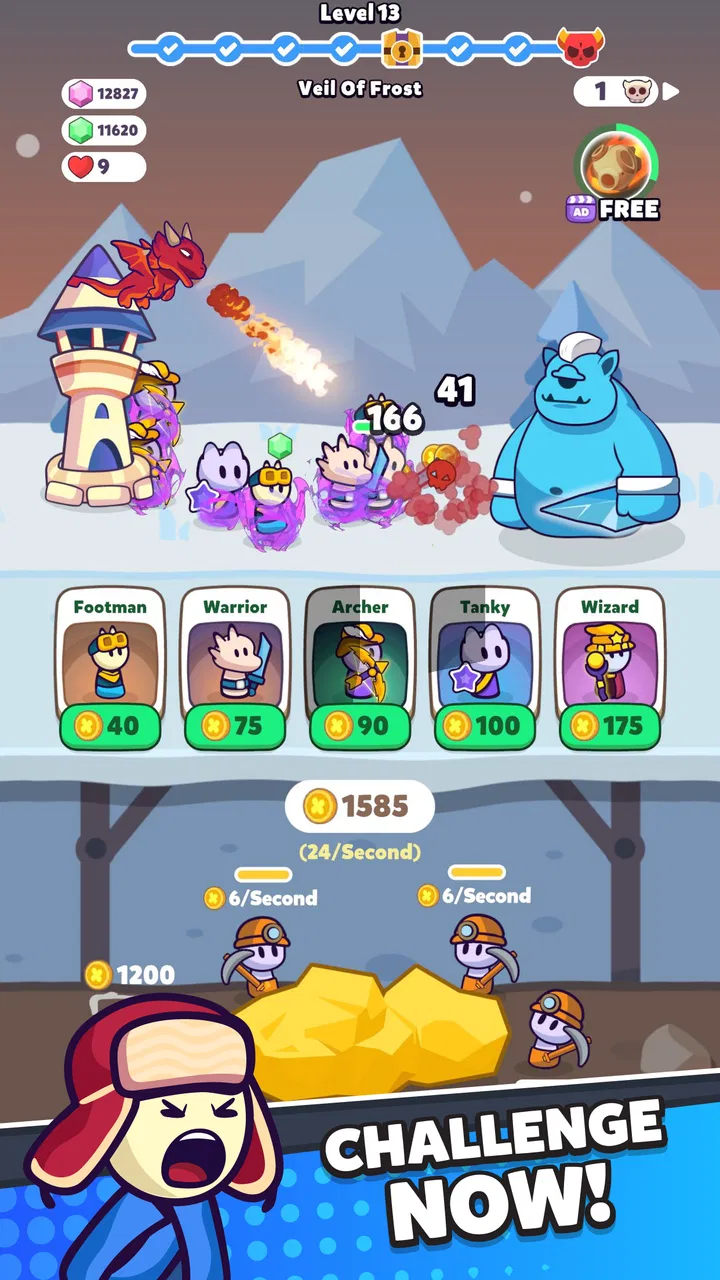
Miner Fighters is a strategy game from Unico Studio that puts its focus on building a team of miners, improving heroes, facing bosses, and working toward rewards. I found it easy to understand within a few minutes, but it is not completely mindless: the useful decisions come from choosing where to invest your resources and deciding how much time you want to spend pushing forward. It is free to download, rated for Everyone, and the current version is 3.3.0.
My first impression was that this is best approached as a compact progression game rather than a deep, traditional strategy title. The appeal is in making a little progress, strengthening the roster, and trying another challenge when the previous one starts to feel manageable. That makes it a natural fit for short sessions, especially when I want something more interactive than a passive idle game but less demanding than a long match-based strategy experience.
What the core loop feels like in practice
The game’s central rhythm is straightforward: recruit miners, develop heroes, take on bosses, and use the rewards to prepare for the next obstacle. That loop gives each session a clear purpose. I am rarely wondering what the immediate objective is, because the next improvement usually points toward a tougher encounter or a more capable team.
You May Also Like

 Pandora - Music & Podcasts
Pandora’s Music Is Easy to Start, but Harder to Recover
Pandora’s strength is its low-effort path from a seed to a station. Its weak spot is how much confidence it asks you to place in connection, setup, and quiet recovery.

 AccuWeather: Weather Radar
AccuWeather Review: A Quick, Clear Forecast for Everyday Decisions
For everyday plans, the best forecast is the one you can understand quickly. AccuWeather makes rain timing, radar, and local conditions easy to act on, with a few trade-offs.

 Hill Climb Racing
Why Hill Climb Racing Still Turns Crashes Into One More Run
A tiny car, a bumpy hill and one more upgrade: Hill Climb Racing keeps resurfacing because its simple chaos makes every near-miss feel personal.

 AliExpress - Shopping App
AliExpress Makes Global Shopping Feel Personal, but Shoppers Bear the Risk
AliExpress turns a global marketplace into a pocket-sized discovery engine. Its reach is useful, its shopping loop compelling, and its trade-offs easy to miss.

 Lords Mobile: Kingdom Wars
Lords Mobile Is a Kingdom-Building Routine, Not a Quick Match
A case-by-case verdict on the building, battles, device demands, and social commitments that make Lords Mobile rewarding for some players and exhausting for others.

 PDF Scanner app - TapScanner
TapScanner Makes Paperwork Easier to Capture, Check, and Share
TapScanner makes scanning with a phone feel less like a rescue operation and more like a dependable step in getting work done. Its capture tools are useful, though not flawless.
More From Our News Desk
View All News


The important distinction is that progress is not only about collecting more characters. A new recruit may be useful, but the value of that recruit depends on how well it fits into the team I am already developing. Spending every resource as soon as it appears can leave a roster that looks stronger on paper while lacking the focused upgrades needed for a difficult boss. I had better results when I treated upgrades as decisions rather than automatic buttons.
Boss fights also give the progression structure some welcome tension. A regular reward feels different when it is clearly helping me prepare for a particular wall. Instead of simply repeating the same activity without a reason, I can connect a mining or recruitment decision to a concrete goal. That relationship between small improvements and larger encounters is where the strategy category feels justified.
Still, players should set their expectations correctly. This is not the kind of strategy game where I spend a long time planning a map, negotiating with several factions, or controlling every unit in a detailed battlefield. Its decisions are narrower and more focused on team growth. If you enjoy optimizing a compact squad and watching it become capable of handling stronger bosses, the format works well. If you want elaborate tactical battles, it may feel light.
How I would handle upgrades and recruitment
My most useful habit was to avoid spreading improvements evenly across everything. A broad collection can be attractive, but limited resources have more impact when they support a clear plan. I would first identify which heroes were actually helping me advance, then consider whether a new recruit solved a problem or merely added another option I was unlikely to use immediately.
This approach matters because recruitment can create a subtle pressure to keep expanding the roster. New characters are exciting, yet every additional option can also make resource choices less obvious. I found it more satisfying to build a dependable core and then use new arrivals to address a weakness, rather than treating every recruit as an automatic replacement.
A practical everyday scenario is a short evening session after work. I might have only a few minutes, so I would check the current team, collect or use available rewards, make one meaningful upgrade, and attempt the next boss. That is enough to create a sense of progress without requiring a full uninterrupted campaign. On a longer weekend session, I could instead compare several upgrade paths and decide whether to strengthen the current lineup or prepare a different combination.
Another useful tip is to judge an upgrade by the obstacle it helps overcome, not only by its immediate numerical gain. A smaller improvement that makes a boss attempt more reliable can be more valuable than a larger-looking upgrade that does not change the outcome of a fight. The game becomes more interesting when I think in terms of thresholds: what is needed to survive, deal enough damage, or make the next attempt worthwhile?
Where the free-to-play model affects the experience
The game is free, but it includes optional in-app purchases ranging from $0.99 to $23.99 per item. That is the key spending context I would want a new player to understand before starting. The purchase range is broad enough that the game should be approached as something playable without assuming that every attractive offer represents good value.
I did not treat the presence of purchases as proof that the game is unfair. A free strategy game needs some way to support development, and optional spending can be reasonable when it saves time without making ordinary progress feel pointless. The more important question is whether I can still make sensible decisions and enjoy the progression without feeling pushed to pay whenever a boss becomes difficult.
My advice is to play long enough to understand the normal rhythm before buying anything. Early excitement can make a bundle look more useful than it really is, especially when I have not yet learned which heroes I prefer or which upgrades matter most. Waiting gives me a clearer idea of whether a purchase would support the way I already play or simply accelerate a system I may not enjoy for long.
There is also a practical budgeting point. Because individual items can have very different prices, I would decide on a personal spending limit before browsing offers. That keeps the decision separate from the pressure of a difficult encounter. If the game is enjoyable when played for free, a small optional purchase can remain optional rather than becoming the assumed cost of participation.
Progression pressure and the point where patience matters
Every progression game has moments when improvement slows down, and Miner Fighters is built around the anticipation of stronger heroes, better preparation, and bigger rewards. That can be motivating, but it can also create pressure to keep checking the game or to spend when a boss is just beyond reach.
I think the healthiest way to play is to accept that a failed attempt can be useful information. Before changing everything, I would ask whether the team needs a focused upgrade, whether a different hero combination makes more sense, or whether I simply need more resources. This prevents the common mistake of reacting to one loss by replacing the entire roster or making several unfocused purchases.
The game suits players who enjoy gradual improvement and do not need constant novelty. A person who likes seeing a weak team become reliable may appreciate the slower parts of the loop. Someone who expects every session to unlock a major feature or deliver a dramatic victory may find the repetition less rewarding.
One trade-off is convenience versus involvement. A more hands-on strategy game might give me richer moment-to-moment control, while a lighter progression game lets me make decisions quickly. Miner Fighters sits closer to the second group. That makes it accessible, but it also means the depth comes from resource judgment and team planning rather than from complex controls during every encounter.
Is the competition fair?
I would be careful about describing Miner Fighters as a competitive game in the strict sense. Its main appeal, as I experienced it, is personal progression through recruitment, upgrades, bosses, and rewards. That means fairness is less about comparing identical skill performances in a live match and more about whether spending changes the feeling of advancement.
From a player’s perspective, a fair experience would let free players make meaningful progress while paying players receive convenience or faster development rather than an unavoidable advantage over everyone else. The purchase range makes this an important question, but I would not assume the answer without seeing how each offer interacts with progression. The responsible conclusion is to judge purchases individually and avoid treating the highest-priced item as necessary.
If your priority is a tightly balanced competitive ladder where every participant has the same tools, this is probably not the first strategy game I would recommend. A traditional match-based title may provide a clearer test of decision-making because each match can begin from a more equal position. Miner Fighters is better suited to players who are comfortable with an individual growth journey and who can enjoy it without turning every obstacle into a spending decision.
For players who do spend, the fairest personal approach is to buy only after identifying a specific benefit. For example, a purchase should solve a problem I already understand, not simply promise a vague feeling of being stronger. If I cannot explain why an item improves my preferred team or removes a particular bottleneck, I would keep playing instead.
What new players should watch during the first sessions
I would begin by learning the relationship between recruitment and upgrades rather than trying to collect everything immediately. Notice which heroes consistently contribute to boss attempts, which rewards help the next meaningful improvement, and where progress begins to slow. That information is more valuable than rushing through the opening portion.
I would also keep a simple mental record of resource priorities. If a reward can be used in several ways, ask which choice moves the current team closer to the next realistic goal. This is especially helpful for players who are used to spending currency instantly in casual games. Delaying a decision for a few minutes can reveal whether the resource is better used on a core hero or saved for a new recruitment opportunity.
A second non-obvious tip is to separate experimentation from commitment. Trying a different hero can teach me something about the roster, but investing heavily in that hero before understanding its role may create regret. I prefer small tests first, followed by deeper upgrades only when the character has proved useful in the specific kind of boss challenge I am facing.
Finally, treat rewards as part of a plan rather than as decoration. The promise of epic rewards is most satisfying when I know what those rewards are helping me accomplish. If I play only to collect, the loop can become repetitive. If I play to reach a clear team milestone, even a modest reward feels connected to a decision I made.
How it compares with other strategy choices
Compared with a large strategy game, Miner Fighters is much easier to pick up. There is no need to learn a broad economy, memorize a long list of buildings, or commit to a lengthy match before seeing progress. That makes it a better choice for a phone session when I want a focused objective and quick feedback.
Compared with a purely idle progression game, it offers more room for personal judgment because recruitment, hero development, and boss preparation give me choices to consider. The trade-off is that it may demand more attention than a game designed mainly to run in the background. I would choose it when I want to participate in the growth process rather than simply return to collect accumulated results.
Compared with a competitive strategy title, it feels less dependent on reaction speed and direct player-versus-player balance. That can be a strength for casual players, younger players, or anyone who dislikes losing because another person has more time to practice. It is a weakness for players who need a strong social contest or a clearly measurable competitive ranking to stay interested.
The best alternative depends on what you want from the category. Choose a deeper tactical game if careful battlefield control is your main attraction. Choose a more passive idle game if you want minimal interaction. Choose Miner Fighters when the appealing middle ground is a team of heroes, incremental upgrades, and boss-focused goals that fit into shorter sessions.
Who should play it, and who should skip it
I would recommend it to players who enjoy collecting a roster without needing an enormous world around it, people who like turning rewards into stronger heroes, and casual strategy fans who prefer manageable sessions. It is also a reasonable option for someone looking for an Everyone-rated game that can be understood quickly but still offers decisions about team development.
I would be more cautious recommending it to anyone who dislikes recurring progression loops or feels uncomfortable with in-app purchase prompts in free games. Even when spending is optional, the presence of items from $0.99 through $23.99 means players who are sensitive to monetization should set boundaries before playing. Parents may also want to supervise purchase settings on a shared device, despite the age rating.
It is not the right choice for me when I want a story-heavy adventure, deep turn-based tactics, or a competitive environment where skill is tested from an equal starting point. Its strengths are narrower: accessible team growth, boss preparation, and the satisfaction of making a roster more capable over time.
What I would still check before committing to long-term play
The game already has a substantial player presence, with over 100 thousand installs, and its average rating is 4.7 from around 2.7 thousand ratings. Those figures suggest that the basic concept connects with many players, but they do not replace personal testing. A high average can tell me that the overall experience is well received; it cannot tell me whether the progression pace or purchase approach suits my preferences.
I would use the first several sessions to answer practical questions for myself: Do I enjoy the boss loop when progress slows? Can I make useful upgrades without feeling rushed? Do the available heroes give me enough room to experiment? Does the free path remain enjoyable when I ignore the shop? Those answers matter more than the initial excitement of recruiting a new character.
I would also pay attention to how version 3.3.0 feels on my device and whether the game remains comfortable over repeated sessions. It supports devices running Android 6.0 or later, which gives it broad compatibility on Android, but compatibility alone does not guarantee that every player will prefer the pacing or presentation. A short trial is the most reliable way to judge that fit.
My final view on Miner Fighters
After spending time with it, I see Miner Fighters as an approachable strategy game built around focused progression rather than elaborate tactical complexity. Recruiting miners, improving heroes, and preparing for bosses creates a clear loop that works particularly well in short sessions. I like that the game gives small decisions a visible purpose when I connect them to the next challenge.
The main caution is the free-to-play context. Since optional items range from $0.99 to $23.99, I would play first, learn the progression, and decide on spending separately from moments of frustration. That approach makes it easier to tell whether I genuinely enjoy the game or merely want to remove a temporary obstacle.
My honest recommendation is to try it as a free, compact team-building strategy game, not as a guaranteed deep competitive experience. If you enjoy patient improvement and boss-focused goals, it can be a pleasant addition to a casual gaming routine. If you need rich tactical control, a story-led campaign, or strict spending-free competitive balance, another strategy game will probably serve you better.
Overall, Miner Fighters earns a positive recommendation from me because its central loop is clear, approachable, and easy to fit around everyday life. The strongest experience comes from making deliberate upgrade choices and treating purchases as optional rather than expected. That combination makes it worth trying for the right player, while its limitations are clear enough that nobody should mistake it for a much deeper strategy format.
FAQs for Miner Fighters
01What is Miner Fighters about?
Miner Fighters is an action-packed game combining mining and combat elements. Players explore underground worlds, mine resources, and battle enemies. The game offers dynamic environments, strategic gameplay, and a variety of tools and weapons to enhance the experience. It’s designed for both casual players and those seeking a more challenging adventure.
02Is Miner Fighters free to play?
Miner Fighters is available as a free-to-play game with optional in-app purchases. These purchases can enhance gameplay by offering additional tools, weapon upgrades, or cosmetic items. While it's possible to enjoy the game without spending money, some players might find these purchases helpful for progressing faster.
03What devices are compatible with Miner Fighters?
Miner Fighters is compatible with both Android and iOS devices. It requires Android version 5.0 or higher and iOS version 11.0 or later. The game is optimized for smartphones and tablets, ensuring smooth performance and high-quality graphics across a range of devices.
04Are there multiplayer features in Miner Fighters?
Yes, Miner Fighters includes multiplayer features. Players can team up with friends or join global players to tackle challenges together. The game supports cooperative play and competitive modes, allowing players to either collaborate on missions or compete in battles, enhancing the social aspect of the game.
05What are the main pros and cons of Miner Fighters?
Pros of Miner Fighters include engaging gameplay, diverse environments, and a strong community aspect due to its multiplayer features. However, some players note that the optional in-app purchases can become costly, and there might be a learning curve for new players unfamiliar with mining or combat mechanics.
Pros
- Engaging multiplayer mode with friends.
- Vibrant graphics and smooth animations.
- Frequent updates with new content.
- Easy to learn with a helpful tutorial.
- Offline mode for uninterrupted play.
Cons
- In-app purchases can be expensive.
- Occasional connectivity issues.
- Limited character customization options.
- Ads can be intrusive at times.
- Requires a stable internet connection.

Miner Fighters
Gallery